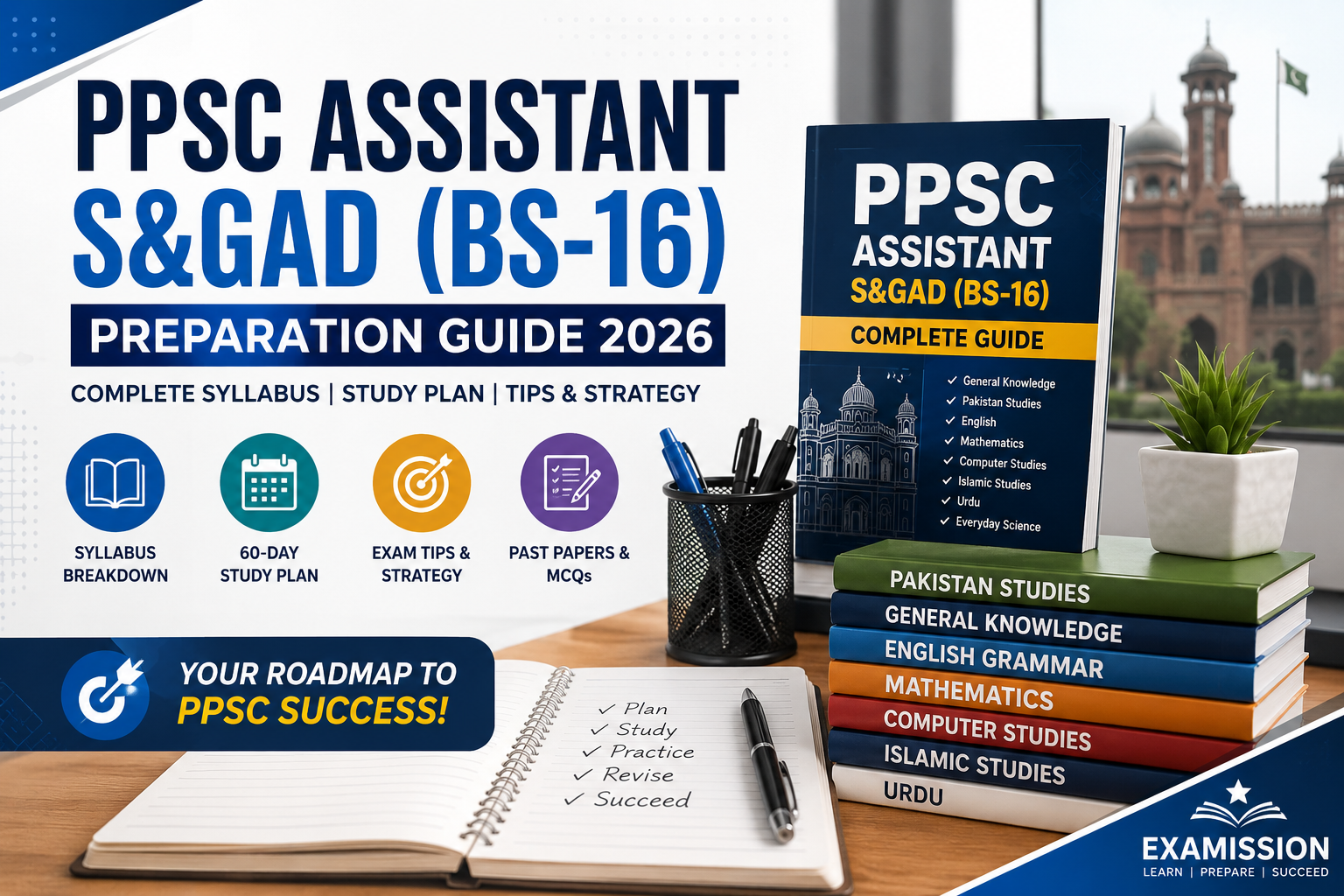
Latest Syllabus, Study Plan, Books, Previous Papers & Expert Tips
Table of Contents
Table of Contents
- Introduction to Assistant S&GAD 2026
- At a Glance
- Expected Eligibility Criteria
- Deep Dive: Exam Overview and Latest Syllabus (2026)
- The 2026 Syllabus Breakdown
- Comprehensive Preparation Strategy: Subject by Subject
- A. General Knowledge & Geography
- B. Pakistan Studies
- C. Current Affairs
- D. Islamic Studies
- E. English Proficiency
- F. Basic Mathematics
- G. Everyday Science & Computer Studies
- H. Urdu
- Previous Paper Analysis: Unlocking the PPSC Mindset
- Trend Analysis (2021 – 2025)
- The 60-Day Master Study Timetable
- Common Mistakes Candidates Make (And How to Avoid Them)
- Critical Mistakes to Avoid Checklist
- ☑ Ignoring Negative Marking
- ☑ Cramming Without Understanding
- ☑ Neglecting Mathematics
- ☑ Poor Time Management
- ☑ Overlooking the Urdu Section
- ☑ Panic During the Exam
- Comparison with Similar Exams
- Final Thoughts and Motivation
- Frequently Asked Questions
- Leave a Reply Cancel reply
Introduction to Assistant S&GAD 2026
Every year, thousands of graduates across Punjab compete for a limited number of government jobs through the Punjab Public Service Commission (PPSC). Among these opportunities, the Assistant (BS-16) in the Services & General Administration Department (S&GAD) is considered one of the most sought-after positions due to its administrative nature, career growth, office environment, and promotion prospects. . This role offers not only administrative authority and job security but also serves as an exceptional stepping stone for ambitious individuals aiming for the Provincial Management Service (PMS) or Central Superior Services (CSS).
The competition is expected to be even tougher in 2026, making smart preparation more important than ever. Many candidates spend months studying but still fail to qualify because they follow random notes, outdated books, or ineffective study methods. On the other hand, candidates who understand the syllabus, practice regularly, and revise strategically often secure excellent marks.
This guide has been prepared to provide a complete roadmap for aspiring candidates. Whether you are preparing for your first PPSC examination or attempting to improve your previous score, this article will help you understand the exam pattern, expected syllabus, preparation strategy, recommended books, previous paper trends, common mistakes, and a practical study timetable.
Important: The exact syllabus, eligibility criteria, and paper pattern are determined by the official PPSC advertisement for the relevant recruitment case. Always verify the latest notification before the examination. The preparation strategies in this guide are based on previous Assistant-level examinations and general competitive exam trends.
At a Glance
| Item | Details |
|---|---|
| Post | Assistant BS-16 |
| Department | S&GAD |
| Recruiting Body | PPSC |
| Test Type | MCQs |
| Time | 90 Minutes |
| Difficulty | Moderate |
| Competition | High |
| Recommended Preparation | 2–3 Months |
Expected Eligibility Criteria
Although candidates should always rely on the official PPSC advertisement, previous Assistant recruitments have generally required the following:
| Requirement | Expected Criteria |
|---|---|
| Education | Bachelor’s Degree (Second Division or equivalent) |
| Domicile | Punjab |
| Gender | Male, Female & Transgender |
| Age | 30 years for males and 33 years for females or As specified in the official advertisement |
| Recruitment | Through PPSC |
Deep Dive: Exam Overview and Latest Syllabus (2026)
The PPSC evaluates candidates for the Assistant S&GAD post through a highly competitive single-paper mechanism. The objective is to assess the breadth of a
candidate’s general knowledge, analytical abilities, linguistic proficiency, and basic computational skills. The Anatomy of the Paper Exam Format: Multiple Choice Questions (MCQs).
Total Marks: 100.
Time Duration: 90 Minutes.
Negative Marking: 0.25 marks are deducted for every incorrect answer. (Four wrong answers negate one correct answer).
Medium of Examination: Bilingual (English and Urdu).
The 2026 Syllabus Breakdown
According to the latest PPSC guidelines and advertisement specifications for 2026, the syllabus comprises a “One Paper MCQs Type General Ability Written Test”. The breakdown is extensive, covering a wide array of disciplines. To prepare intelligently, you must understand the weightage (approximate based on historical trends) assigned to each domain:
| Subject / Domain | Approximate Weightage | Core Focus Areas |
|---|---|---|
| General Knowledge (World) | 15–20% | World Geography, Capitals, Currencies, International Organizations (UN, EU, OIC), Major Treaties, Global Demographics |
| Pakistan Studies | 15% | Pre-Partition History (712 AD to 1947), Post-Partition Political History, Constitutional Developments (1956, 1962, 1973), Geography of Pakistan |
| Current Affairs | 10–15% | National and International Events of the last 18–24 months, Global Conflicts, Economic Indices, Treaties, Political Appointments |
| Islamic Studies | 10% | Life of the Holy Prophet (PBUH), Khulafa-e-Rashideen, Battles (Ghazawat), Basic Pillars of Islam, Quranic Details (Ethics for Non-Muslims) |
| English (Grammar & Composition) | 15% | Synonyms, Antonyms, Prepositions, Active/Passive Voice, Direct/Indirect Speech, Idioms, Sentence Correction |
| Basic Mathematics | 10% | Percentages, Ratios, Proportions, Averages, Profit & Loss, Algebra, Basic Geometry, Time/Distance/Work Problems |
| Urdu | 10% | Urdu Grammar, Famous Authors/Poets and Their Books, Idioms (Zarb-ul-Misal), Historical Literary Movements |
| Everyday Science & IT | 10% | Human Anatomy, Vitamins, Solar System, Physics/Chemistry Basics, MS Office (Word, Excel, PowerPoint), Internet Basics, Shortcut Keys |
This syllabus requires a holistic approach. A common mistake candidates make is overinvesting time in Pakistan Studies while completely ignoring Basic Mathematics or Basic Computer Studies—sections that often serve as the deciding factor for the final merit list.
Comprehensive Preparation Strategy: Subject by Subject
To outshine thousands of applicants, you need a targeted, subject-specific strategy. Below is a blueprint for tackling each component of the PPSC syllabus efficiently;
A. General Knowledge & Geography
GK is a vast ocean. Start by categorizing it. Memorize world capitals, currencies, and geographic superlatives (longest, largest, highest). Use maps actively. When you study a country, locate it on the map, check its neighboring countries, its capital, and any recent news associated with it. Pro-Tip: Use mnemonic devices to remember lists of countries in organizations like SAARC or ASEAN. Focus on physical geography (straits, oceans, mountain ranges like the Himalayas, Andes, Alps). Click Here for Preperation of Subject for InshaAllah Guranteed Success
B. Pakistan Studies
Divide this into three phases:
Phase 1: Arrival of Islam to 1857 (Muhammad Bin Qasim, Delhi Sultanate, Mughal Empire).
Phase 2: 1857 to 1947 (Aligarh Movement, Partition of Bengal, Khilafat Movement, 14 Points of Jinnah, Pakistan Resolution, Cabinet Mission).
Phase 3: 1947 to Present (Constitutions, martial laws, major political transitions, geography of Pakistan including rivers, dams, and mountain passes like Bolan and Khyber). Click Here for Preperation of Subject for InshaAllah Guranteed Success
C. Current Affairs
Current Affairs cannot be crammed overnight. Develop a habit of reading a reputable newspaper like Dawn or The News. Focus on the editorial pages. For PPSC MCQs, keep a dedicated notebook. Jot down major appointments (e.g., current DG ISI, Chief Justice of Pakistan, UN Secretary-General), ongoing global conflicts (e.g., Russia-Ukraine, Middle East), sports events (World Cups, Olympics), and major summits (G20, COP). Since the exam is in 2026, focus intensely on events from 2024 to early 2026. Click Here for Preperation of Subject for InshaAllah Guranteed Success
D. Islamic Studies
This section is highly scoring. PPSC tends to ask detailed questions about the life of Prophet Muhammad (PBUH) in Makkah and Madinah, the dates of hazawat (Badr, Uhud, Khandaq, Tabook), and the lives of the four Rightly Guided Caliphs. Additionally, focus on compilation of the Holy Quran, famous Tafseers, and undamental concepts of Zakat and Hajj (e.g., how many times the word Zakat appears in the Quran). Click Here for Preperation of Subject for InshaAllah Guranteed Success
E. English Proficiency
The English section is often the primary stumbling block for many. The focus is strictly on grammar and vocabulary. Master the rules of prepositions—this alone covers 3-4 marks in every PPSC paper. Practice converting Active to Passive voice and Direct to Indirect speech until it becomes second nature. For vocabulary, memorize a list of 500 high-frequency GRE/CSS level words along with their synonyms and antonyms. Regular reading naturally enhances your sentence structure intuition. Click Here for Preperation of Subject for InshaAllah Guranteed Success
F. Basic Mathematics
Do not fear the math section. It is basic, usually of 8th to 10th-grade level. Key topics include BODMAS rule, fractions, percentages, average, and ratio-oportion. Work on speed. In a 90-minute exam, you cannot afford to spend 5 minutes on a single math problem. Learn mental math tricks and formulas for calculating compound interest and work-time problems (e.g., If A does work in 4 hours, and B in 3 hours, how long together?). Click Here for Preperation of Subject for InshaAllah Guranteed Success
G. Everyday Science & Computer Studies
Everyday Science requires a foundational understanding of biology (human body, vitamins, diseases), physics (units of measurement, light, sound), and hemistry (gases, basic elements). For Computer Science, focus heavily on MS Office (Word, Excel, PowerPoint). Memorize shortcut keys (e.g., Ctrl+K for hyperlink, Ctrl+E for center alignment). PPSC heavily tests basic IT literacy, such as definitions of RAM, ROM, operating systems, and basic networking protocols. Click Here for Preperation of Subject for InshaAllah Guranteed Success
H. Urdu
Urdu is notoriously tricky in PPSC exams. Questions often revolve around famous literary works and their authors (e.g., “Aab-e-Hayat” by Muhammad Hussain Azad, works of Allama Iqbal, Faiz Ahmad Faiz, and Ghalib). You must also brush up on Urdu grammar (Ism, Fail, Harf) and common idioms (Zarb-ul-Misal).
Expert Insight: The Power of Elimination In multiple-choice exams with negative marking, guessing wildly will destroy your score. Instead, use the elimination method. Rule out the two obviously incorrect options. If you can narrow it down to two choices, the statistical probability favors taking an educated guess. If you are clueless about all four options, leave thequestion blank. Protecting your score from negative marking is just as important as accumulating positive marks. Click Here for Preperation of Subject for InshaAllah Guranteed Success
Expert Insight: The Power of Elimination
In multiple-choice exams with negative marking, guessing wildly will destroy your score. Instead, use the elimination method. Rule out the two obviously ncorrect options. If you can narrow it down to two choices, the statistical probability favors taking an educated guess. If you are clueless about all four options, leave the question blank. Protecting your score from negative marking is just as important as accumulating positive marks
Related Resources
- Assistant S&GAD MCQs
- Pakistan Affairs MCQs
- Computer MCQs
- Everyday Science MCQs
- Current Affairs Notes
- PPSC Mock Tests
Previous Paper Analysis: Unlocking the PPSC Mindset
To formulate a robust strategy, we must analyze the trends from previous S&GAD Assistant exams, particularly looking at papers from 2021, 2023, and 2025. Analyzing past papers reveals the examiner’s psychology and the recurring themes.
Trend Analysis (2021 – 2025)
- Repetition is Real: PPSC frequently recycles questions. Our analysis shows thatnearly 20-30% of questions in the S&GAD Assistant paper are direct repeats or slight variations of questions asked in previous years (including other departmental exams like Tehsildar or PMS General Knowledge).
- Shift Towards Conceptual IT: While earlier exams asked basic questions like “What is the brain of the computer?”, recent papers (2023-2025) have shifted to practical MS Office applications. For instance, asking about specific functions in Excel (e.g., VLOOKUP, pivot tables) or niche shortcut keys.
- Current Affairs Dominance: The weightage of current affairs has slightly increased. Questions regarding recent constitutional amendments, global reaties, and economic statistics of Pakistan are frequently featured
- English Prepositions: Fill-in-the-blanks with appropriate prepositions (e.g., “He is averse _ hard work”) consistently make up 4-5 questions.
The 60-Day Master Study Timetable
Success requires discipline. Below is an intensive 60-day timetable designed to ensure you cover every aspect of the syllabus comprehensively while leaving ample time for revision and mock tests.
| Days | Primary Subject Focus | Secondary Daily Habit (1–2 Hours) |
|---|---|---|
| Day 1–10 | Pakistan Studies & Islamic Studies (Deep dive into history, dates, and concepts) | Read Dawn newspaper + Solve 1 Past Paper (Imtiaz Shahid). |
| Day 11–20 | General Knowledge & Geography (Continents, Capitals, Organizations, Maps) | Learn 20 English vocabulary words daily + Solve 1 Past Paper. |
| Day 21–30 | English Grammar (Prepositions, Active/Passive Voice, Direct/Indirect Speech) | Prepare Current Affairs notes + Solve 1 Past Paper. |
| Day 31–40 | Basic Mathematics (Arithmetic, Percentages, Ratios, Algebra Basics) | 30 minutes Urdu Grammar + Solve 2 Past Papers. |
| Day 41–45 | Everyday Science (Biology, Physics & Chemistry Basics) | Revise General Knowledge facts + Solve 2 Past Papers. |
| Day 46–50 | Computer Studies (MS Office, Internet, Shortcut Keys) | Mathematics practice + Solve 2 Past Papers. |
| Day 51–55 | Consolidated Revision (Re-read highlighted notes and weak areas) | Revise Current Affairs of the last two years. |
| Day 56–60 | Full-Length Mock Exams (Attempt 100 MCQs in 90 minutes and analyze mistakes) | Light reading, relaxation, and mindset preparation. |
Common Mistakes Candidates Make (And How to Avoid Them)
Even brilliant candidates fail PPSC exams. Why? Because competitive exams test temperament as much as knowledge. Here are the fatal errors you must avoid:
Critical Mistakes to Avoid Checklist
☑ Ignoring Negative Marking
Attempting all 100 questions blindly can reduce your final score. If you are certain about only a portion of the paper and guess the remaining questions without any basis, negative marking can significantly affect your merit position.
How to Avoid It:
- Attempt questions you know confidently.
- Make educated guesses only after eliminating unlikely options.
- Skip questions where you have no clue instead of random guessing.
☑ Cramming Without Understanding
Memorizing past papers without understanding the concepts is a common mistake. According to the guide, PPSC often changes a single word in a repeated question, which can completely alter the correct answer.
How to Avoid It:
- Understand the concept behind each MCQ.
- Review why the incorrect options are wrong.
- Use past papers as a learning tool rather than a memorization exercise.
☑ Neglecting Mathematics
Many candidates skip the mathematics portion to save time. However, these questions can contribute valuable marks because they are based on objective calculations.
How to Avoid It:
- Practice basic arithmetic daily.
- Focus on percentages, ratios, averages, and time & work.
- Improve calculation speed through regular practice.
☑ Poor Time Management
Spending too much time on one difficult question reduces the time available for easier questions.
How to Avoid It:
- If a question takes more than 45 seconds, move on and return to it later.
- Complete easy questions first.
- Reserve the final few minutes to review unanswered questions.
☑ Overlooking the Urdu Section
Many candidates assume Urdu requires no preparation because it is their native language. However, PPSC Urdu questions often focus on specialized grammar and literary knowledge.
How to Avoid It:
- Revise Urdu grammar regularly.
- Practice idioms (Zarb-ul-Misal), synonyms, antonyms, and literary works.
- Solve previous Urdu MCQs.
☑ Panic During the Exam
A difficult first page can shake a candidate’s confidence. The guide notes that questions are randomized, so easier questions may appear later in the paper.
How to Avoid It:
- Stay calm if the opening questions seem difficult.
- Continue through the paper instead of losing confidence.
- Maintain focus and trust your preparation.
Comparison with Similar Exams
How does the Assistant S&GAD exam compare to other popular competitive exams in Pakistan? Understanding this helps in cross-preparation.
Assistant S&GAD vs. PMS (Provincial Management Service) GK Paper: Both are 100- mark MCQ papers. However, the PMS GK paper tends to be slightly more analytical and heavier on deep General Knowledge, whereas the S&GAD paper balances all 8-9 subjects evenly. If you prepare for PMS GK, your S&GAD preparation is almost 80% complete automatically.
Assistant S&GAD vs. FIA Assistant / Sub-Inspector: FIA exams conducted by FPSC generally have a strong emphasis on English (20 marks strictly) and strictly avoid the Urdu section. PPSC includes Urdu and has a slightly different pattern of negative marking. FPSC does not have negative marking (in most general recruitment tests), which changes the entire exam strategy.
Assistant S&GAD vs. Tehsildar / Naib Tehsildar: The Tehsildar exam usually involves multiple papers, including a dedicated English paper and a dedicated Revenue Laws paper. Assistant S&GAD is a single-paper general ability test, making it less specialized but equally competitive due to the broader syllabus.
Final Thoughts and Motivation
The journey to passing the PPSC Assistant S&GAD exam is a test of perseverance as much as intellect. The 2026 cycle brings new opportunities and intense competition. The merit will be high, but the syllabus is finite and highly manageable with the right strategy.
Do not let the sheer number of applicants intimidate you. Out of 50,000 applicants, only the top 10% are serious contenders who have studied systematically. The rest are casual applicants. By following the 60-day timetable, mastering past paper trends, and
protecting yourself from negative marking, you are already placing yourself in the top percentile.
Success in the Assistant S&GAD examination is not determined by the number of books you own, but by how consistently you prepare. Download the official syllabus, create a realistic study schedule, practice MCQs every day, and evaluate your progress through mock tests.
If you found this guide helpful, explore the Assistant S&GAD MCQs, Previous Papers, Mock Tests, and Current Affairs resources available on ExaMission to strengthen your preparation.
Editorial Team – ExaMission
This guide has been prepared by the ExaMission Editorial Team after reviewing recent PPSC recruitment trends, previous examination patterns, and publicly available syllabus information. It is intended as a preparation resource and should be read alongside official PPSC notifications.