The Ultimate Guide to the Nobel Prize: History, Laureates, World Impact, and Modern Legacy
An exhaustive exploration of humanity’s most prestigious award—from Alfred Nobel’s explosive bequest to the groundbreaking achievements shaping physics, chemistry, medicine, literature, peace, and economics.
[ FEATURED IMAGE PLACEHOLDER ]
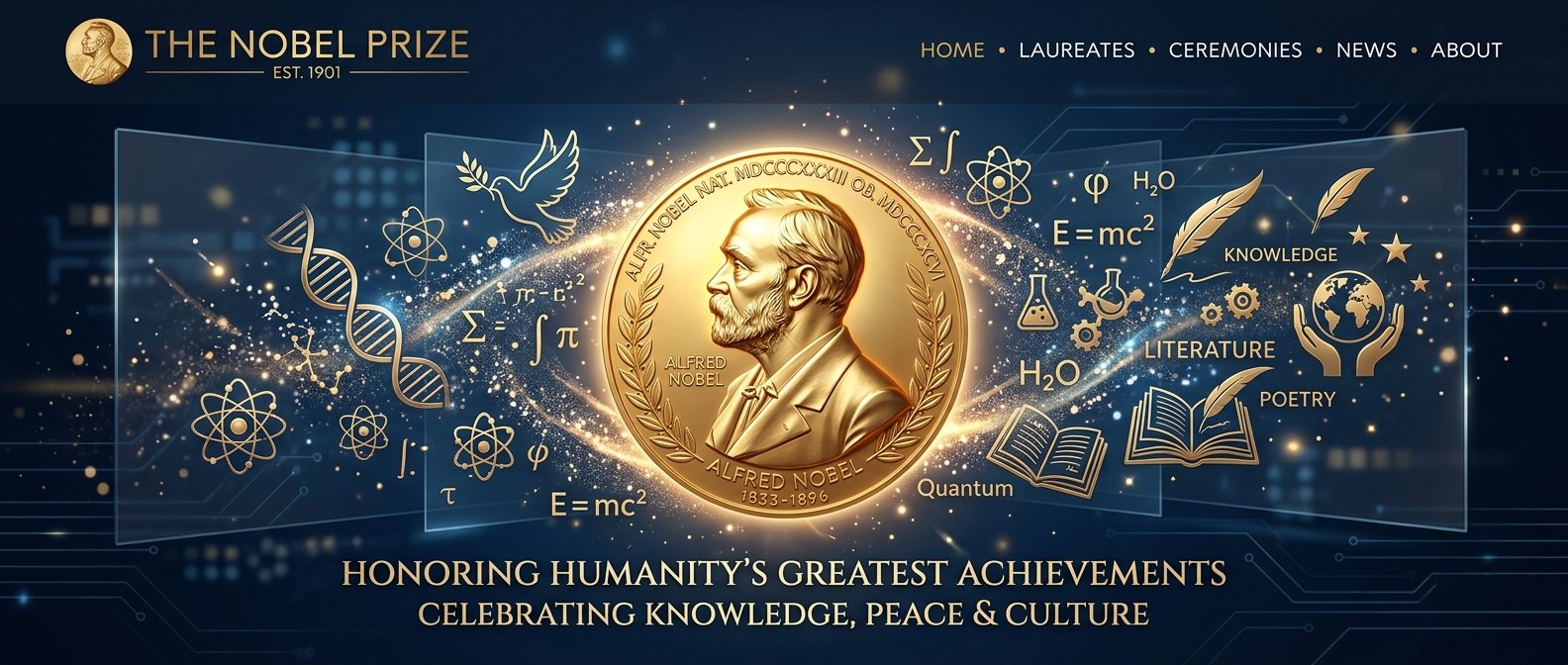
Visual Concept: High-resolution 3D metallic golden Nobel Medal displaying Alfred Nobel’s profile, surrounded by scientific diagrams, world peace symbols, literary manuscripts, and modern economic charts.
Alt Text: Golden Nobel Prize medal showcasing Alfred Nobel’s profile surrounded by scientific and peace iconography.
Caption: The Nobel Prize medal remains the supreme global symbol of intellectual accomplishment and humanity-benefiting achievement.
Every year in early October, the international scientific, literary, and geopolitical communities hold their collective breath. Announcements echoing from Stockholm and Oslo define human achievement, immortalizing men and women whose intellect, dedication, and courage have bestowed the “greatest benefit on humankind.” The Nobel Prize is not merely an honor; it is the absolute pinnacle of human recognition.
From Albert Einstein’s explanation of the photoelectric effect to Marie Curie’s pioneering research on radioactivity, and from Martin Luther King Jr.’s crusade for civil rights to Malala Yousafzai’s fearless advocacy for education, the history of the Nobel Prize is the story of modern civilization itself.
💡 Essential Knowledge for Candidates & Scholars
Mastering the historical, scientific, and geopolitical facts regarding Nobel Laureates is vital for high-scoring success in competitive examinations, general knowledge assessments, and international civil service tests.
🚀 Accelerate your study schedule with comprehensive learning resources at Examission Complete Preparation. Test your baseline readiness across various disciplines using the PPSC & FPSC Mock Test Series.
1. The Enigmatic History: From Dynamite to Perpetual Legacy
The birth of the Nobel Prize is tied to irony, regret, and the desire for redemption. Alfred Bernhard Nobel (1833–1896), a Swedish chemist, engineer, inventor, and entrepreneur, accumulated vast wealth through his 355 inventions. Among these, his most famous—and dangerous—creation was dynamite, patented in 1867, alongside blasting gelatin and ballistite.
📰 “The Merchant of Death is Dead”
In 1888, Alfred’s brother Ludvig died in Cannes, France. A French newspaper mistakenly published Alfred’s obituary instead, bearing the infamous headline: “Le marchand de la mort est mort” (“The merchant of death is dead”). The article condemned him for inventing explosives that accelerated warfare lethality. Horrified by this premature reflection of his legacy, Alfred resolved to reshape how history would remember him.
The Historic Last Will of 1895
On November 27, 1895, at the Swedish-Norwegian Club in Paris, Alfred Nobel signed his final will and testament. He specified that 94% of his total assets—amounting to 31 million Swedish Kronor (equivalent to over $220 million USD today)—be allocated to create an endowment fund. The annual interest generated by this fund was to be distributed as prizes to those who conferred the “greatest benefit on humankind” across five specific disciplines:
- Physics: To the person who made the most important discovery or invention.
- Chemistry: To the person who made the most important chemical discovery or improvement.
- Physiology or Medicine: To the person who made the most important discovery in medical science.
- Literature: To the person who produced in the field of literature the most outstanding work in an ideal direction.
- Peace: To the person who done the most or best work for fraternity between nations, abolition or reduction of standing armies, and the holding and promotion of peace congresses.
Despite intense legal resistance from relatives and skepticism from political figures, the Nobel Foundation was established in 1900, and the first Nobel Prizes were awarded on December 10, 1901—the fifth anniversary of Alfred Nobel’s death.
2. The Six Nobel Categories Explained
Today, six distinct prizes are presented annually. While five were established by Alfred Nobel’s original 1895 will, the sixth was instituted in 1895 by Sweden’s central bank. Let us examine the scope and modern significance of each discipline.
Nobel Prize in Physics
Awarded by the Royal Swedish Academy of Sciences. Honors revolutionary breakthroughs in quantum mechanics, astrophysics, laser technology, relativity, and condensed matter physics.
Exam Focus: Test your understanding of scientific advances in our General Knowledge MCQs.
Nobel Prize in Chemistry
Awarded by the Royal Swedish Academy of Sciences. Focuses on molecular biology, gene editing (CRISPR), macromolecular structures, lithium-ion batteries, and organocatalysis.
Physiology or Medicine
Awarded by the Nobel Assembly at the Karolinska Institute. Recognizes transformational medical developments such as mRNA vaccine technology, DNA sequencing, penicillin, and neurobiology.
Nobel Prize in Literature
Awarded by the Swedish Academy. Celebrates authors whose lifetime body of work demonstrates exceptional literary merit, philosophical depth, and mastery of prose or poetry.
Literary Preparation: Practice terminology and authors with English Literature MCQs.
Nobel Peace Prize
Awarded by the Norwegian Nobel Committee in Oslo. Honors extraordinary efforts in conflict resolution, human rights advocacy, disarmament, and global diplomacy.
Diplomatic Affairs: Keep pace with global events at Current Affairs MCQs.
Economic Sciences
Instituted by Sveriges Riksbank in 1895. Honors landmark contributions to macroeconomic theory, behavioral economics, game theory, and empirical market analysis.
3. The Selection Process: How Winners Are Chosen
The nomination and selection system for Nobel Prizes is rigorous, secretive, and elaborate. Nominations are by invitation only, with thousands of qualified university professors, previous laureates, parliamentary leaders, and research scientists submitting proposals each year.
📅 The Annual Nomination & Award Timeline
Over 3,000 confidential invitation forms are issued to qualified nominators worldwide. Self-nominations are automatically disqualified.
All formal nominations must reach their respective committees.
Specialist committees, aided by international experts, evaluate candidate accomplishments and distill nominations down to a final shortlist.
Laureates are chosen via majority vote. The decisions are final, unappealable, and immediately announced around the globe.
Prizes are formally presented in Stockholm (Physics, Chemistry, Medicine, Literature, Economics) and Oslo (Peace). Laureates receive a gold medal, custom diploma, and monetary award document.
4. Legendary Laureates Who Changed World History
Throughout Nobel history, select individuals have achieved towering prominence due to their extraordinary discoveries, moral leadership, or multiple Nobel recognitions.
| Laureate | Category & Year | Key Contribution / Impact |
|---|---|---|
| Marie Curie | Physics (1903) Chemistry (1911) | First woman to win a Nobel; first person to win two prizes in distinct scientific fields (Radioactivity, Polonium, Radium). |
| Albert Einstein | Physics (1921) | Awarded for services to theoretical physics, especially his discovery of the law of the photoelectric effect. |
| Sir Alexander Fleming | Medicine (1945) | Discovery of penicillin, unlocking modern antibiotic medicine and saving hundreds of millions of lives. |
| Martin Luther King Jr. | Peace (1964) | Non-violent resistance against racial inequality in the United States. |
| Malala Yousafzai | Peace (2014) | Youngest Nobel recipient ever (age 17) for advocating for girl’s education rights globally. |
For students preparing regional and historical general knowledge modules, studying notable figures from South Asia—such as Dr. Abdus Salam (Physics, 1979) and Malala Yousafzai (Peace, 2014)—is essential. Check out structured guides on Pakistan Studies MCQs and Islamic Studies MCQs.
5. Famous Nobel Controversies, Snubs, & Omissions
No global award is without controversy. Over its century-long history, several decisions by the Nobel committees sparked international debate, political backlash, or profound regret.
🚫 The Great Omission: Mahatma Gandhi
Mahatma Gandhi was nominated five times (1937, 1938, 1939, 1947, and early 1948) but was never awarded the Nobel Peace Prize. Following his assassination in January 1948, the Norwegian Nobel Committee considered a posthumous award but opted to withhold the Peace Prize that year, stating there was “no suitable living candidate.” Decades later, members of the committee publicly expressed regret over this omission.
Other Notable Controversies
- Rosalind Franklin (1962 DNA Discovery): Franklin’s critical X-ray diffraction data (Photo 51) was vital in determining the double-helix structure of DNA. However, she passed away in 1958 at age 37, and Nobel statutes explicitly forbid posthumous awards. James Watson, Francis Crick, and Maurice Wilkins received the prize in 1962.
- Henry Kissinger (Peace Prize, 1973): Awarded alongside Le Duc Tho for negotiating the Vietnam cease-fire. Le Duc Tho refused the prize, stating peace had not actually been achieved, while Kissinger’s award triggered public protests and the resignation of two Nobel committee members.
- Lise Meitner (1944 Nuclear Fission): Meitner provided the theoretical explanation for nuclear fission alongside Otto Hahn, yet Otto Hahn was awarded the Nobel Prize in Chemistry individually.
6. The Sveriges Riksbank Prize in Economic Sciences
Technically known as the Sveriges Riksbank Prize in Economic Sciences in Memory of Alfred Nobel, this award is not one of the five original prizes set up by Alfred Nobel’s 1895 will. It was established in 1968 by Sweden’s central bank to mark its 300th anniversary.
While managed by the Nobel Foundation and presented at the same ceremony, it has occasionally faced scrutiny regarding whether economics should share the stage with physical sciences and literature. Nevertheless, economics laureates—such as Milton Friedman, Amartya Sen, Daniel Kahneman, and Claudia Goldin—have fundamentally reshaped world trade, poverty alleviation models, market regulation, and labor economics.
📊 Quantitative & Analytical Mastery
Economic and mathematical models form a foundational part of global competitive exams. Practice foundational concepts at Basic Mathematics MCQs and test your computer literacy with Computer Studies MCQs.
7. Rapid-Fire Nobel Prize Facts for Global Competitive Exams
If you are preparing for international civil service exams, university entry tests, or recruitment screenings, memorize these high-frequency facts:
Strengthen your overall test performance using curated study tracks across multiple domains:
📚 Examission Competitive Exam Learning Hub
Access targeted study material designed for high-stakes examinations:
8. Frequently Asked Questions (FAQ)
Click on any question below to expand the full answer:
What does a Nobel Laureate receive upon winning? +
- A Nobel Diploma: A unique piece of artwork created by leading Swedish and Norwegian artists and calligraphers.
- A Nobel Medal: Handcrafted in 18-karat recycled gold, featuring the image of Alfred Nobel.
- A Cash Prize: A monetary award (currently set at 11 million Swedish Kronor, approx. $1.0 million USD per full prize) to support continued work or research.