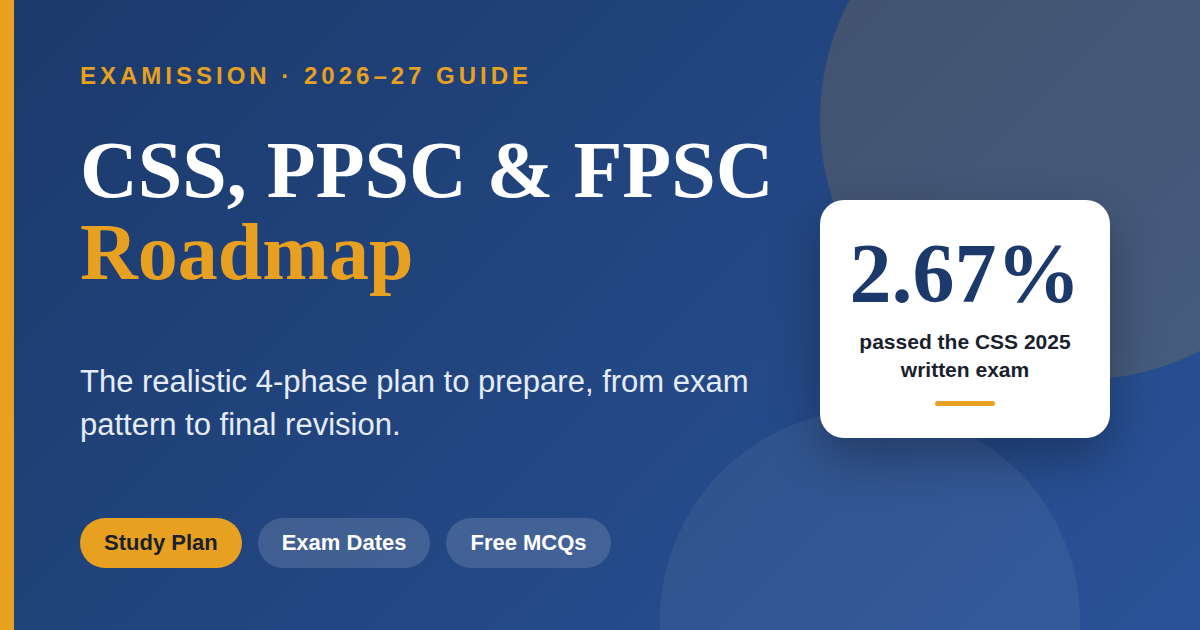
How to Prepare for CSS, PPSC & FPSC in 2026–27: The Realistic Roadmap
Only 2.67% of CSS 2025 candidates passed the written exam. This guide shows what that number really means, what the exams actually test, and a phase-by-phase plan you can start today, built on official patterns, not rumours.
1. The reality check (read this first)
In CSS 2025, 355 of 12,792 applicants cleared the written stage and 170 were recommended for appointment. That is a pass rate of 2.67%, and no candidate was allocated to the Foreign Service of Pakistan that year.
What this means for you: hard work alone is not the differentiator, because almost everyone who applies works hard. What separates the 2.67% is a system: knowing exactly what is examined, practising it under exam conditions, and fixing weak papers before the exam does it for you. The rest of this guide is that system.
No article, including this one, can promise you a seat. What it can do is stop you wasting months on the wrong things.
2. CSS exam structure and passing rules
The CSS is 1,500 marks: 1,200 written plus 300 viva voce. It runs in stages, and you must clear each in order.
| Stage | What it is | Counts in merit? |
|---|---|---|
| 1. MPT (screening) | MCQ test, 200 questions in 200 minutes; pass mark reported as 33% (66/200) | No, qualifying only |
| 2. Written exam | 12 papers, 1,200 marks | Yes |
| 3. Medical | Physical fitness check | Qualifying only |
| 4. Psychological assessment | Group tasks, written and individual sessions | Qualifying only |
| 5. Viva voce | Oral interview before an FPSC panel | Yes, 300 marks |
The 12 written papers
| Block | Papers | Marks |
|---|---|---|
| Compulsory (6) | English Essay · English Précis & Composition · General Science & Ability · Current Affairs · Pakistan Affairs · Islamic Studies / Comparative Religion | 6 × 100 = 600 |
| Optional (6) | Chosen from the optional subject groups (e.g. Accountancy & Auditing, Economics, Computer Science, Political Science, International Relations, Law, History, Geography, Sociology, and more) | 600 |
The two rules that decide outcomes: you need at least 33% in every paper and 50% aggregate across all 1,200 written marks. Failing one compulsory paper, most often English, ends the attempt even if your total is high. Candidates get a maximum of 3 attempts, and the age window is 21 to 30 (with relaxation for specified categories).
Subject-group choice rules have wording that is easy to misread. Always confirm your optional-subject combination against the current FPSC notification before committing.
3. CSS 2027 timeline (as of 17 October 2026)
Date change to know about: FPSC originally set the CSS 2027 screening test for 27 September 2026, then rescheduled it to Saturday 10 October 2026 after a protest was announced for the original date. The other dates were reported as unchanged.
| Milestone | Date |
|---|---|
| MPT applications | 3 to 20 August 2026 |
| MPT (rescheduled) | 10 October 2026 (already held; watch fpsc.gov.pk for results) |
| Written exam advertisement | 8 November 2026 |
| Written exam online applications | 10 to 25 November 2026 |
| Hard copies due at FPSC HQ | 4 December 2026 |
| Written exams begin | 27 January 2027 |
Only candidates who passed the MPT may apply for the written exam. If you missed this cycle, treat the next 12 months as a head start: the structure above does not change from year to year, and a Senate committee discussed raising the CSS age limit in July 2026 but reached no decision.
4. PPSC and FPSC MCQ exams
Most government job tests in Punjab and at federal level are not the CSS. They are objective papers, and the winning skill is accuracy under time pressure.
- Typical PPSC written test: 100 marks in 90 minutes for most posts, with 0.25 marks deducted per wrong MCQ.
- Passing: commonly 40% in the objective paper, and 50% aggregate to qualify the interview stage.
Always check your specific advertisement. Pattern, syllabus and negative marking vary by post and can change. Treat the figures above as a typical baseline, not a promise.
With negative marking, a blind guess has a lower expected value than an educated elimination. Skip questions where you cannot remove at least one option.
5. The 4-phase roadmap
Work in phases with a checkpoint at the end of each. Do not move on until the checkpoint is met.
Weeks 1–2: Diagnose
- Take a full mixed MCQ test cold, with no revision, to find your real baseline.
- Download the official syllabus for your target post and tick every topic as strong, shaky or unknown.
- Checkpoint: a one-page list of your 5 weakest topics.
Weeks 3–8: Build the base
- Cover compulsory subjects first: English, Pakistan Studies, Islamic Studies, General Science, Current Affairs.
- Study a topic, then immediately drill 20–30 MCQs on it. Reading without testing is the biggest time sink.
- Keep an error log: question, why you missed it, the rule that fixes it.
- Checkpoint: 70%+ on topic tests across all compulsory subjects.
Weeks 9–12: Practise like the exam
- Solve past papers against the clock, with the real negative-marking rule applied.
- Re-attempt everything in your error log. Repeated mistakes are cheap marks.
- Checkpoint: two consecutive mock scores above your target cut-off.
Final weeks: Revise and sharpen
- Short daily timed sets, revision of the error log, and a monthly current-affairs sweep.
- Sleep and routine beat a last-week cram.
- Checkpoint: your error log is shrinking, not growing.
6. Subject-by-subject strategy
Practise each subject by topic, then mix. All of these have free, solved MCQs on ExaMission.
English
Grammar, vocabulary, comprehension. The paper that most often ends CSS attempts, so start it first.
Practise English MCQs →Pakistan Studies
Constitutional history, ideology, geography and foreign policy.
Practise Pakistan Studies →Current Affairs
National and world events. Read monthly, not daily, and test yourself on each month.
Practise Current Affairs →Islamic Studies
High-scoring and fact-driven; accuracy matters more than volume.
Practise Islamic Studies →Then move to PPSC & FPSC solved past papers to see how questions are really framed.
7. Mistakes that sink candidates
- Collecting resources instead of using them. One good source revised five times beats five sources read once.
- Ignoring the weakest paper. A single paper under 33% overrides everything else in the CSS.
- Never practising under time. Knowing the answer slowly is not the same as scoring.
- Guessing blindly under negative marking. Eliminate first, then decide.
- Relying on unofficial notices. Dates and patterns change, as the CSS 2027 MPT reschedule showed. Verify on fpsc.gov.pk and ppsc.gop.pk.
Start your diagnostic today
Pick a subject, take a timed set, and log every mistake. That one habit does more than another month of passive reading.
Start practising freeLatest Pakistan Current Affairs8. Frequently asked questions
How many people pass the CSS written exam?
In CSS 2025, 355 of 12,792 applicants (2.67%) cleared the written stage, and 170 were recommended for appointment.
What is the CSS passing criteria?
At least 33% in each written paper and 50% aggregate across the 1,200 written marks, followed by the medical, psychological assessment and viva stages.
When was the CSS 2027 screening test?
FPSC rescheduled it from 27 September to 10 October 2026. The written exam is scheduled to begin on 27 January 2027, with the advertisement due on 8 November 2026.
Is there negative marking in PPSC tests?
Commonly yes, 0.25 marks per wrong MCQ, but check the advertisement for your specific post.
How many attempts do I get for the CSS?
A maximum of three attempts, within the 21 to 30 age window (relaxation applies for specified categories).
Sources
- Aaj News: CSS 2025 results, pass rate 2.67%
- ProPakistani: FPSC announces new date for CSS 2027 MPT
- ARY News: CSS 2027 schedule issued
- ARY News: Senate committee discusses CSS age limit proposal
- CSSPrep: CSS exam format and structure
- Ilmkidunya: PPSC exam pattern
This guide is informational and not an official FPSC or PPSC publication. Confirm all dates, patterns and eligibility on fpsc.gov.pk and ppsc.gop.pk before acting.