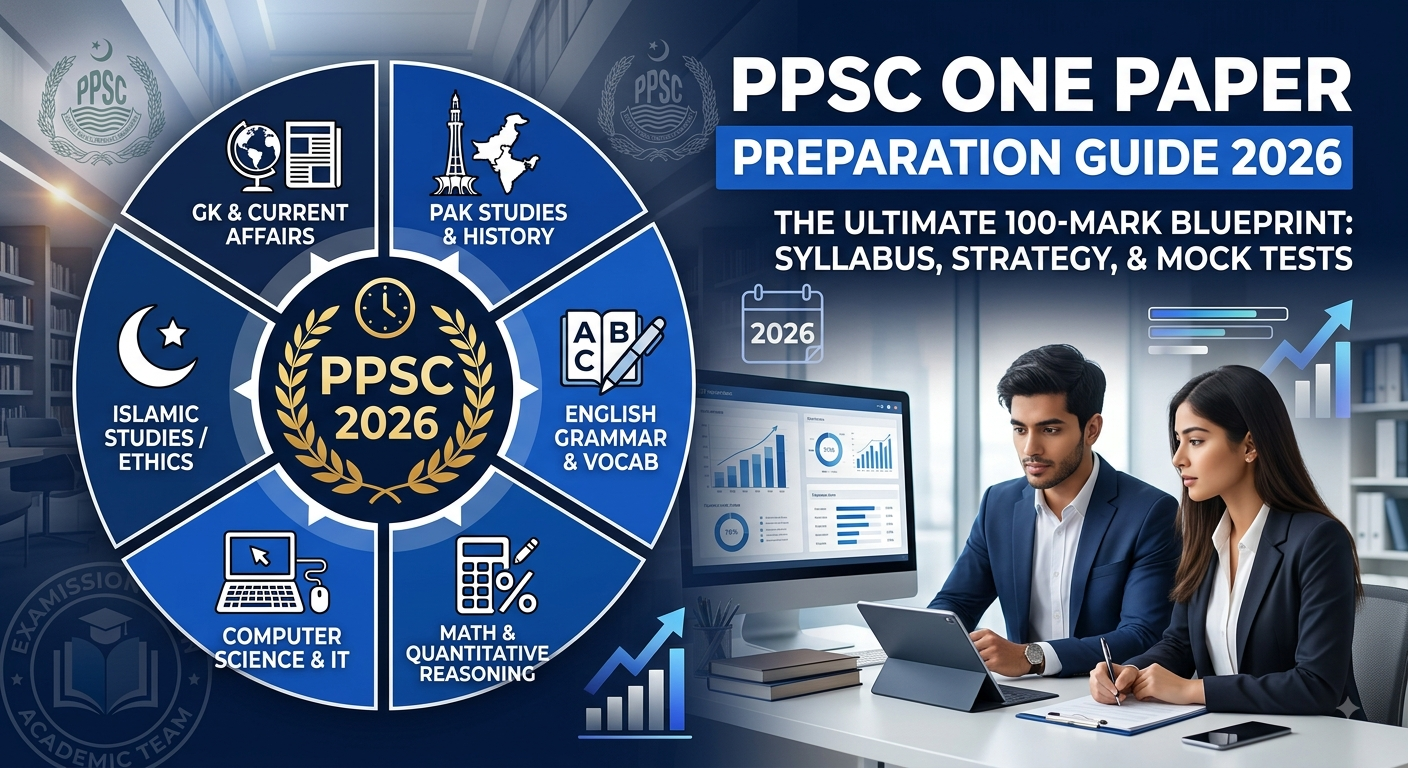
PPSC One Paper Preparation Guide 2026: The Ultimate 100-Mark Blueprint
Cracking the Punjab Public Service Commission (PPSC) recruitment test in 2026 requires moving beyond outdated rote-learning methods. Every year, over three hundred thousand ambitious candidates across Punjab apply for coveted government positions ranging from Junior Clerks (BS-11) and Sub-Inspectors (BS-14) to Tehsildars, Assistant Directors, and Child Protection Officers (BS-17). However, fewer than five percent manage to clear the rigorous PPSC One Paper MCQ Screening Test.
Why do so many bright graduates fall short? The answer is simple: PPSC has fundamentally revamped its questioning framework over the past two years. The commission has gradually phased out direct, static facts in favor of analytical, conceptual, and contemporary questions that demand a strategic preparation model. Merely memorizing past paper answer keys without understanding underlying concepts will no longer secure a seat on the final merit list.
At ExaMission, our academic panel has analyzed over 250 official PPSC past papers conducted between 2020 and 2026. We have distilled these insights into this comprehensive, 100-mark preparation roadmap. Whether you are appearing for your very first PPSC exam or looking to score above 75+ to guarantee an interview call, this guide covers every detail you need to master the syllabus, tackle negative marking, and excel.
📖 Table of Contents (Quick Navigation)
- 1. Understanding the PPSC One Paper Exam Blueprint & Marking Scheme
- 2. Comprehensive 10-Subject Syllabus & Breakdown
- 3. The 90-Day Step-by-Step Preparation Roadmap
- 4. Strategic Handling of Negative Marking & Exam Psychology
- 5. Analyzing Solved Past Papers: Trends vs. Traps
- 6. Essential Study Resources, Books, and Digital Notes
- 7. Taking Interactive Mock Tests for Speed and Accuracy
- 8. Frequently Asked Questions (FAQ Accordion)
- 9. Final Verdict & Expert Advice from ExaMission
1. Understanding the PPSC One Paper Exam Blueprint & Marking Scheme
The standard PPSC One Paper test is a written competitive examination consisting of 100 Multiple Choice Questions (MCQs) to be completed within a total duration of 90 minutes. While certain specialized technical posts reserve 80% weightage for professional qualifications and 20% for General Knowledge, the vast majority of general executive, clerical, and administrative vacancies rely 100% on the general syllabus test.
📊 Key Test Architecture Parameters
-
Total Questions: 100 Objective Type MCQs
Total Marks: 100 Marks
Allowed Time: 90 Minutes (54 seconds per question)
Negative Marking: 0.25 Marks deducted for each incorrect answer
Passing Threshold: Official qualifying mark is 40%, but realistic merit cutoff ranges between 68 to 82 marks depending on seats and applicant density.
Medium of Exam: English (except for Urdu literature portion)
Understanding time constraint physics is vital. You have exactly 54 seconds per question. However, reading a complex math word problem or an intricate English statement can take up to 90 seconds. Thus, building rapid pattern recognition for static subjects like General Knowledge, Islamic Studies, and Pakistan Studies is essential to bank time for Mathematics and English comprehension.
2. Comprehensive 10-Subject Syllabus & Breakdown
The official PPSC notification broadly defines the One Paper syllabus as General Knowledge, Pakistan Studies, Islamic Studies (or Ethics for non-Muslim candidates), Current Affairs, Geography, Basic Mathematics, English, Urdu, Everyday Science, and Basic Computer Studies. Let us break down each of these 10 distinct domains with their exact weightage and essential focus topics for 2026.
| Subject Title | Average Weightage | Difficulty Level | Primary Exam Focus |
|---|---|---|---|
| General Knowledge (GK) | 15 – 20 Marks | Moderate to High | World organizations, boundaries, capitals, famous historical events |
| Pakistan Studies | 10 – 12 Marks | Moderate | 1712-1947 History, Constitutional Era (1956, 1962, 1973), Key personalities |
| Islamic Studies / Ethics | 10 – 12 Marks | Easy to Moderate | Quranic facts, Ghazwat, Prophet’s life, Caliphate history, Pillars |
| Current Affairs | 10 – 12 Marks | High (Dynamic) | National economic metrics, summits, bilateral treaties, global leadership 2025-2026 |
| English Language | 10 – 12 Marks | High | Prepositions, idioms, sentence structure, active/passive, vocabulary |
| Urdu Language & Literature | 10 – 12 Marks | Moderate | Grammar, Muhaware, Zarb-ul-Masal, prominent poets & novels |
| Basic Mathematics | 10 – 12 Marks | Moderate to High | Percentages, ratios, age problems, average, speed & distance, algebra |
| Everyday Science | 8 – 10 Marks | Moderate | Human body, solar system, vitamins, inventions, physics laws |
| Computer / IT Skills | 8 – 10 Marks | Moderate | MS Office 365, keyboard shortcuts, operating systems, networking basics |
| Geography | 8 – 10 Marks | Moderate | Physical geography, continents, rivers, straits, deserts, mountain passes |
Subject 1: General Knowledge (GK)
General Knowledge forms the backbone of the screening test. PPSC frequently tests candidates on world history, geographic extremes, international treaties, and international organizations (UN agencies, SAARC, SCO, NATO, ASEAN). Candidates must memorize headquarters, acronyms, and founding years. For a structured collection of high-yield questions, explore our dedicated section on General Knowledge MCQs.
Subject 2: Pakistan Studies
Pakistan Studies is broadly split into two historical phases: Pre-Independence (1712 to 1947) and Post-Independence (1947 to present). High-frequency topics include the War of Independence 1857, Sir Syed Ahmad Khan’s reforms, the Lucknow Pact 1916, Nehru Report vs. Quaid-e-Azam’s 14 Points, 3rd June Plan, and the constitutional evolution under the 1956, 1962, and 1973 constitutions. Prepare exhaustive historical timelines through our curated Pakistan Studies MCQs repository.
Subject 3: Islamic Studies / Ethics
For Muslim candidates, Islamic Studies covers the biography of Prophet Muhammad (PBUH), major Ghazwat (Badr, Uhud, Khandaq, Hunain), the Rashidun Caliphate, compile history of the Holy Quran, famous Hadith compilations (Sihah-e-Sitta), and fundamental pillars (Zakat, Hajj, Sawm rules). Non-Muslim candidates are provided alternative questions on general ethics and moral philosophy. Test your grasp with Islamic Studies MCQs.
Subject 4: Current Affairs (National & International)
PPSC current affairs questions focus heavily on major events that took place over the last 12 to 18 months. You must stay updated on federal budget highlights, CPEC project developments, climate summits (COP meetings), regional diplomatic shifts, major sports events (ICC, Olympics), and newly appointed domestic and international heads of state. Access real-time monthly updates on Current Affairs MCQs.
Subject 5: English Grammar, Syntax & Vocabulary
English is often the decisive subject that separates top performers from average scorers. PPSC focuses on practical usage rather than pure literary theory. Essential topics include preposition usage, correction of sentences, subject-verb agreement, direct and indirect speech, active/passive voice transformations, and contextual synonyms/antonyms. Sharpen your grammatical accuracy using English MCQs.
Subject 6: Urdu Language & Literature (اردو و ادب)
The Urdu section tests basic grammar, idioms, proverbs, and classical literary history. Expect questions on famous books and their authors (e.g., Mirza Ghalib, Allama Iqbal, Faiz Ahmad Faiz, Ashfaq Ahmed), literary titles, Urdu grammar rules (Isam, Fail, Harf, Sanaee Badaee), and completion of famous proverbs (ضرب المثل اور محاورے). Practice authentic past questions on Urdu MCQs.
Subject 7: Basic Mathematics & Quantitative Reasoning
Mathematics in PPSC is aligned with matriculation-level arithmetic and basic algebra. Questions focus on word problems involving percentage calculations, ratio and proportion, profit and loss, simple and compound interest, averages, age calculation problems, time and work equations, and basic geometry formulas. Practice topic-wise quantitative problems at Basic Mathematics MCQs.
Subject 8: Computer Science & Information Technology
Computer literacy has become mandatory for almost all public service positions in Punjab. PPSC questions evaluate practical knowledge of Microsoft Office Suite (Word, Excel, PowerPoint, Access), operating system fundamentals, shortcut keys (CTRL+C, CTRL+Z, F5, F12), computer hardware, internet protocols (TCP/IP, HTTP), and cybersecurity basics. Master essential tech terms with our Computer MCQs collection.
Subject 9 & 10: Everyday Science & World Geography
Everyday science tests basic concepts in biological sciences (human digestive system, blood groups, diseases, deficiency of vitamins), physical sciences (laws of motion, sound speed, light refraction), and astronomical facts (planets, solar eclipse, atmospheric layers). Meanwhile, World Geography covers landlocked countries, major straits (Strait of Hormuz, Malacca), deepest trenches, mountain ranges (Himalayas, Andes, Alps), and global rivers.
3. The 90-Day Step-by-Step Preparation Roadmap
To cover this vast syllabus without feeling overwhelmed, structured planning is mandatory. We recommend a 90-day preparation strategy divided into three distinct 30-day phases.
📅 Phase 1: Core Foundation Building (Days 1 – 30)
Dedicate 4 to 5 hours daily. Focus exclusively on fundamental concepts rather than attempting rapid quiz solving. Divide your time equally between historical timelines (Pak Studies & Islamiyat), basic arithmetic rules, and English grammar fundamentals. Read authentic text sources or introductory guides before touching MCQ banks.
📅 Phase 2: Topical MCQ Mastery & Past Paper Analysis (Days 31 – 60)
Shift towards topical practice. Solve subject-specific question banks on ExaMission. During this phase, study official past papers from 2021 to 2026. Do not merely read the correct option; investigate the four options provided in each question. If a question asks about the founder of an institution, take a minute to learn about the other three personalities listed in options B, C, and D.
📅 Phase 3: Time-Bound Mock Exams & Revision (Days 61 – 90)
The final month should be reserved for full-length 100-mark timed simulation tests. Set a strict 90-minute timer and attempt mock papers without external help. Analyze your error patterns daily. Maintain an “Error Notebook” where you log every incorrect answer and review it before sleeping.
4. Strategic Handling of Negative Marking & Exam Psychology
Negative marking is the primary filter PPSC uses to eliminate unprepared candidates. Under the official rules, **0.25 marks are deducted for every wrong answer**. This means that 4 wrong answers completely nullify 1 correct answer.
⚠️ Mathematical Proof of Blind Guessing Penalty
Suppose you blindly guess 20 questions where you have zero knowledge. Statistically, you might get 5 correct and 15 wrong.
• Marks earned: +5.0
• Marks lost to penalty: 15 × 0.25 = -3.75
• Net yield: +1.25 marks out of 20 (A massive risk that usually results in a net negative score under real exam pressure).
The 3-Round Attempt Technique
To maximize your net score while minimizing penalties, apply the 3-Round Attempt Strategy during the 90-minute examination:
- Round 1 (Absolute Certainty): Go through the entire paper from Question 1 to 100 in 35 minutes. Answer ONLY those questions where you are 100% sure of the correct option. Typically, a well-prepared candidate marks 45 to 55 questions in Round 1.
- Round 2 (Intelligent Elimination): Revisit questions where you can confidently eliminate 2 out of the 4 choices. When you narrow a question down to 2 options, your statistical probability of success rises to 50%. Educated guessing here yields a net positive score over time.
- Round 3 (Danger Zone – Avoid): Questions where all 4 choices look completely unfamiliar should be left blank. Leaving a question unattempted costs 0 marks, whereas a wild guess costs -0.25.
5. Analyzing Solved Past Papers: Trends vs. Traps
A common myth among aspirants is that PPSC simply repeats identical questions from old past paper books. While it is true that 40% to 50% of concepts repeat, PPSC examiners frequently tweak the question wording, reverse the options, or ask about related historical figures.
For instance, if a 2022 paper asked: “In which year was the Simla Deputation presented?” (Answer: 1906), a 2026 paper might ask: “Who led the 35-member Muslim delegation during the Simla Deputation in 1906?” (Answer: Sir Aga Khan III).
Therefore, studying past papers effectively requires 360-degree learning around each question. You can access solved, verified past papers and exam simulations through our PPSC Solved Past Papers & Mock Tests Hub.
6. Essential Study Resources, Books, and Digital Notes
Avoid cluttering your study space with dozen different books. Quality and repeated revision beat quantity every single time. Here is the recommended resource stack approved by top-ranking candidates:
📚 Recommended Core Booklist
- General Knowledge & Past Papers: Caravan Advanced PPSC Model Papers by M. Imtiaz Shahid or Dogar’s Unique PPSC Master Guide.
- English Grammar: High School English Grammar & Composition by Wren & Martin, supplemented by GRE Word Lists for vocabulary.
- Basic Mathematics: Quantitative Aptitude by R.S. Aggarwal or General Ability Notes by ExaMission.
- Pakistan Affairs & History: Trek to Pakistan by Ahmad Saeed / Concise History of Pakistan.
- Digital E-Books & Digest Notes: PDF subject guides and past paper digests available directly at ExaMission E-Books Portal.
Combine traditional textbook study with daily online testing on ExaMission to reinforce your memory and track your progress across individual subjects.
7. Taking Interactive Mock Tests for Speed and Accuracy
Knowledge without time management is meaningless in competitive examinations. Sitting in an examination hall under strict time limits creates mental pressure that often leads to careless bubbling errors on the OMR sheet.
To prevent exam-day anxiety, simulate realistic test conditions at least twice a week during the final month. Use real answer sheets, set a timer for 90 minutes, and practice filling answer bubbles accurately. To evaluate your real-time performance against thousands of other Punjab applicants, attempt our online PPSC Full-Length Mock Test.
8. Frequently Asked Questions (FAQ Accordion)
Below are clear answers to the most common queries raised by PPSC aspirants regarding eligibility, test formats, and preparation strategies.
What is the passing mark in PPSC One Paper test, and what is a safe score for merit?
How is negative marking calculated in PPSC MCQs tests?
How many months of preparation are needed to clear PPSC on the first attempt?
Are past papers enough to clear the PPSC screening exam in 2026?
Which computer skills are tested in PPSC general tests?
Can candidates from other provinces apply for PPSC jobs?
How can I improve my English grammar and vocabulary for PPSC?
What is the best way to prepare Current Affairs for PPSC 2026?
What happens if I make a mistake while bubbling the roll number on the OMR sheet?
Where can I download free PPSC preparation e-books and past paper digests?
9. Final Verdict & Expert Advice from ExaMission
Securing a public sector job through the Punjab Public Service Commission is a life-changing milestone that offers career stability, social prestige, and an opportunity to serve the public. While the competition is fierce, the path to success is entirely predictable: **Systematic Study + High-Yield Resources + Smart Exam Strategy = Selection**.
Stop jumping between unverified WhatsApp groups or memorizing outdated key books with wrong answer keys. Focus your energy on systematic, subject-wise mastery. Start your preparation journey today with verified practice tests, past papers, and expert notes on ExaMission — Pakistan’s trusted platform for competitive exam preparation.
🚀 Ready to Crack PPSC 2026?
Access thousands of free, topic-wise solved MCQs, full-length timed mock exams, and authentic past paper PDFs now.
Start Free Preparation on ExaMission